
The global food packaging crisis is real. Every day, millions of plastic food containers are used once and immediately thrown away.
This massive volume of waste is a key contributor to plastic pollution, clogging ecosystems and consuming precious landfill space.
Switching to sustainable food packaging isn’t just a trend—it’s a critical step for the planet and a major plus for any modern business or household.
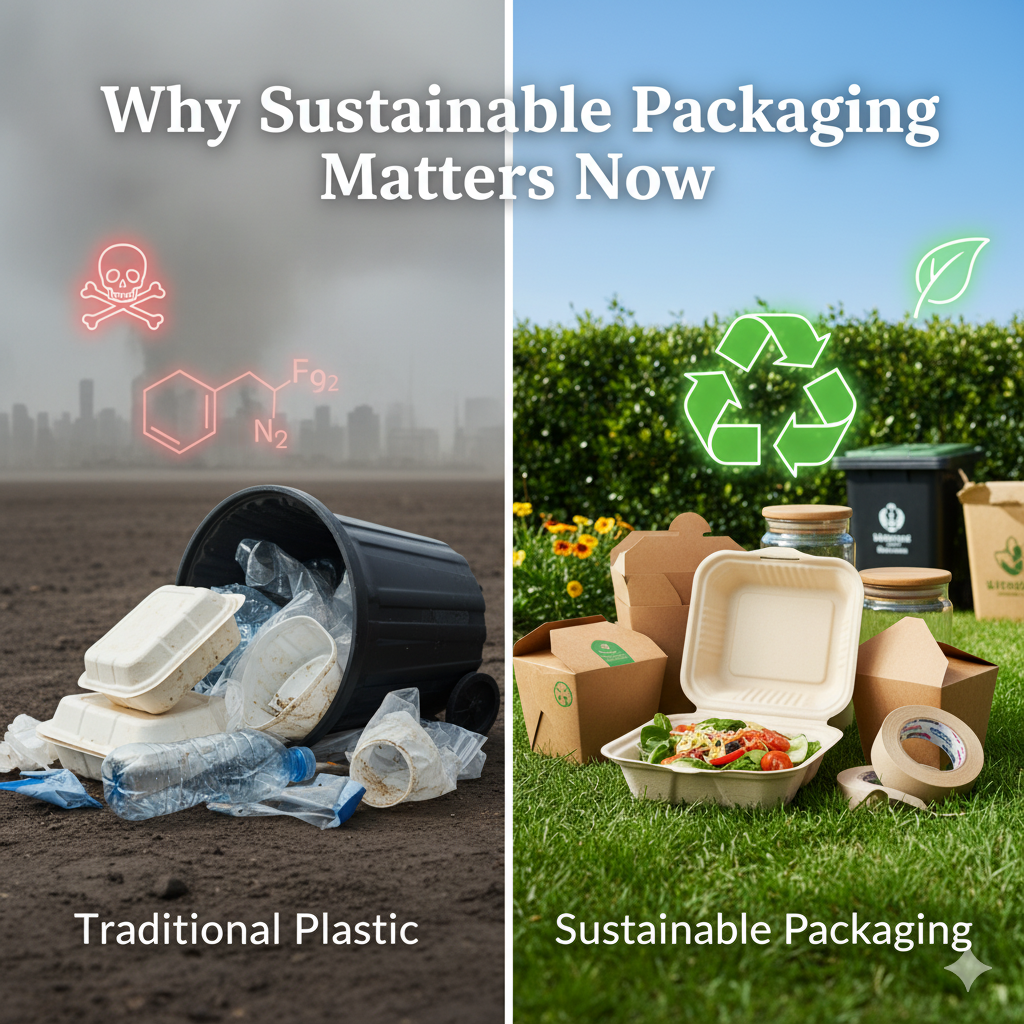
Why Sustainable Packaging Matters Now
Consumers are increasingly demanding greener options. Choosing eco-friendly containers shows your commitment to the environment and boosts your brand image.
- Consumer Demand: 85% of consumers worldwide prefer brands that use sustainable packaging. (Source: Trivium Packaging Survey)
- Reduced Carbon Footprint: Manufacturing processes for many green materials use significantly less energy and water than producing virgin plastics.
- Faster Decomposition: Alternatives break down in weeks or months, not centuries.
The Hidden Costs of Traditional Plastic
Traditional plastic packaging often contains harmful chemicals that can leach into food, especially when heated. Eco-friendly alternatives provide a safer, cleaner option.
🌿 Top 6 Materials for Eco-Friendly Food Containers
Here are the best materials revolutionizing the food packaging industry, broken down by their function and environmental benefits.
1. Bagasse (Sugarcane Fiber) Containers
Bagasse is the dry fibrous pulp left after sugarcane stalks are crushed to extract their juice. It’s a waste product turned into a sustainable packaging hero.
- Pros: Microwave and freezer safe, incredibly sturdy, oil/water resistant, and fully compostable.
- Cons: Not suitable for long-term food storage (designed for single-use).
- Best For: Takeaway boxes, restaurant clamshells, and portion control containers.
2. Recycled Paper and Cardboard
Paper is easily recyclable and widely accepted in most recycling programs. Look for options labeled with a high percentage of Post-Consumer Recycled (PCR) content.
- Pros: Highly customizable, lightweight, easy to print on, and widely accepted for recycling.
- Cons: Requires a PLA or wax lining to be grease-proof or leak-proof.
- Best For: Burger wraps, dry food containers, bakery boxes, and drink carriers.
3. Plant-Based PLA/CPLA Liners
These are used as liners in paper cups and bowls to make them waterproof. PLA (Polylactic Acid) is made from renewable resources like corn starch.
- Key Fact: While plant-based, PLA and CPLA generally require industrial composting facilities to break down fully.
- Best For: Lining coffee cups, cold food salad bowls, and juice containers.
4. Glass Containers
For reusable, long-term storage, glass is unbeatable. It is non-porous, doesn’t absorb odors, and can be reused indefinitely.
- Pros: 100% recyclable forever without loss of quality, excellent for reheating food, and aesthetically appealing.
- Cons: Heavy, breakable, and has a higher initial cost.
- Best For: Home meal prep, restaurant high-end reusable delivery programs, and preserving food.
5. Aluminum Containers
Aluminum is lightweight, durable, and frequently used for catering trays and beverage cans. It is one of the most recycled materials globally.
- Pros: Excellent barrier against air and light, infinitely recyclable, and heat-resistant (great for oven use).
- Fact: Aluminum recycling requires 95% less energy than producing new aluminum. (Source: The Aluminum Association)
- Best For: Prepared meals that need heating, large catering dishes, and beverage storage.
📊 Comparison Table: Selecting the Right Container
This comparison helps businesses and consumers quickly weigh the pros and cons of the top disposable eco-friendly options.
| Material | Primary Advantage | Decomposition Time | Heat Safe? | Recycling/Composting |
| Bagasse | Extremely sturdy, grease-proof | 60–90 days (Compost) | Yes | Industrial/Home Compost |
| Recycled Paper | Low cost, lightweight | 60 days (Compost) | No | Recycle (if unlined) |
| PLA Liners | Leak-proof barrier | Industrial Composting only | No (Melts) | Industrial Composting |
| Aluminum | Infinitely Recyclable | N/A | Yes (Oven/Freezer) | Recycle |
🖼️ Visual Content Strategy for Engagement
A powerful visual can communicate your message faster than text and is crucial for top rankings.
Image/Infographic Idea: “The Green Packaging Hierarchy” Infographic
Infographic Content:
- Top Tier (Best): Glass Containers (Caption: Reuse indefinitely)
- Middle Tier: Bagasse & Paper (Caption: Compostable disposable)
- Bottom Tier (Worst): Polystyrene/Plastic (Caption: Avoid at all costs)
- Visual Element: Show a graphic illustrating Bagasse breaking down into rich soil.
❓ Frequently Asked Questions
Q: Are all “biodegradable” containers compostable? A: No, this is a common misconception. Biodegradable is a broad term. Always look for certifications like “Compostable” or “Compostable in Industrial Facilities” for clarity.
Q: How do I dispose of a Bagasse container properly? A: You can usually throw Bagasse containers into your home compost pile or municipal green waste bin. Always check local guidelines first.
Q: Is PLA packaging truly sustainable if it requires industrial composting? A: It is more sustainable than petroleum-based plastics because it uses renewable resources. However, its effectiveness depends entirely on local composting infrastructure availability.
Q: Can I use aluminum takeout containers in the microwave? A: No, never put aluminum in the microwave. It can cause sparks and damage the appliance. It is safe for conventional ovens and freezers.
About the Author
Hi there! I’m Kalpita , a sustainability consultant specializing in business transitions to eco-friendly operations. I help companies and consumers understand and implement effective waste reduction strategies. Let’s make sustainable choices the easy choice!